
Chief of Naval Operations Admiral Jonathan W Greenert characterised navy-to-navy ties as "solid and growing" and said bilateral wargames had progressed from "two ships going by doing flashing lights...probably about a decade ago, to coordinated operations, carrier air wing and under sea".
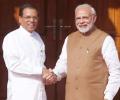
'Modi's first foreign trip at the very outset of his second term as PM reinforces a growing impression that this regional tour underscores a shift in emphasis in India's foreign policy that was traditionally focused on the northern tier of countries to the Indian Ocean rim,' explains Ambassador M K Bhadrakumar.

'As in the Panchatantra tale of the cat and the monkeys, it is possible for the clever swing State to play off the two competing powers.'
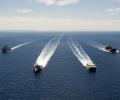
In the lead up to this week Indo-US Strategic Dialogue, for which United States Secretary of State, John Kerry, will be coming to Delhi, the Indo-US defence engagement is even more intense than usual.

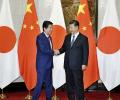
'Both Japan and China face a common challenge: How to deal with Trump.' 'The trade war with the US seems to have facilitated/hastened Abe's China visit, the first by a Japanese prime minister since 2011,' points out Dr Rajaram Panda.
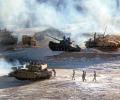
India's national security strategy needs to be revised periodically since the global and regional geopolitical situation is dynamic, points out Commodore Venugopal Menon (retd).

Defence Minister Manohar Parrikar expects to see progress in India-US defence relations at the speed of a year per month.

Admiral Sam Locklear heads the US Pacific Command, making him the most powerful military commander on earth. With 60 per cent of the US Navy under him, PACOM oversees 52 per cent of the planet. Locklear is America's military pointsman for 36 countries, including India and China.

National Geographic was kind enough to let us display the winning images and honourable mentions from the four categories: Wildlife, Landscapes, Aerials, and Underwater.

That Australia is ready for a substantive engagement is evident from its 2013 Defence White Paper, which emphasised the need to build stronger defence relations with India, says Ajai Shukla
Powerful senators write to US Defense Secretary Hagel to support a robust defence relationship with India to achieve shared goals and form an unwavering bond between the world's two largest democracies. Aziz Haniffa in Washington, DC

At a time when Donald Trump is making belligerent noises, Chinese President Xi Jinping responds by overhauling the People's Liberation Army and restructuring the command of the PLA Navy to emphasise Beijing's resolve to dominate the South China Sea.

The US foreign and security policy establishment, says Ambassador M K Bhadrakumar, apprehends that Trump may compel them to exorcise the 'unipolar predicament', and bring foreign and security policies to reflect the desires and priorities of the American public.

Today humanity is churning the ocean with a thoughtless vengeance -- with toxic wastes, plastics and hazardous substances being dumped into our once pristine seas. And there is no benign Lord Shiva to rescue us from our collective greed, says Shyam Saran.
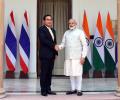
Thailand's importance to India's Act East policy is too significant to be overlooked.

'There is no Buddha or Gandhi among countries, existing for the service of others; they all exist for the good of themselves.' 'For each country, its own interests should be paramount, and it is futile and churlish to expect China to be an exception to this rule,' says B S Raghavan, the distinguished civil servant and long-time China-watcher.

The India that needs strategic alliances, defence cooperation and engaging meaningfully with neighbouring countries is quietly moving ahead with confidence, says Tarun Vijay

'To consider BRICS anything more than a temporary club with some common interests would be folly. The goal should be to induce others (Japan, ASEAN, South Africa) to align with us -- a non-threatening, democratic nation, rather than with malevolent China or waning America. For us to consider aligning with either China or the US would be absurd. India is just too big to be a sidekick,' says Rajeev Srinivasan.

'If the dimensions of the strategic partnership worked out by India and the US seem like a grand alliance targeted at you-know-who, China had better realise that it has fathered it,' says B S Raghavan, a long time observer of China.

'India should think big: About how in a multi-polar world, India can indeed be one of the poles, rather than being a secondary power that has to worry about 'alignment' with one of the poles. A G3 in other words, India should look to getting others to align with itself rather than the US or China,' says Rajeev Srinivasan.
